
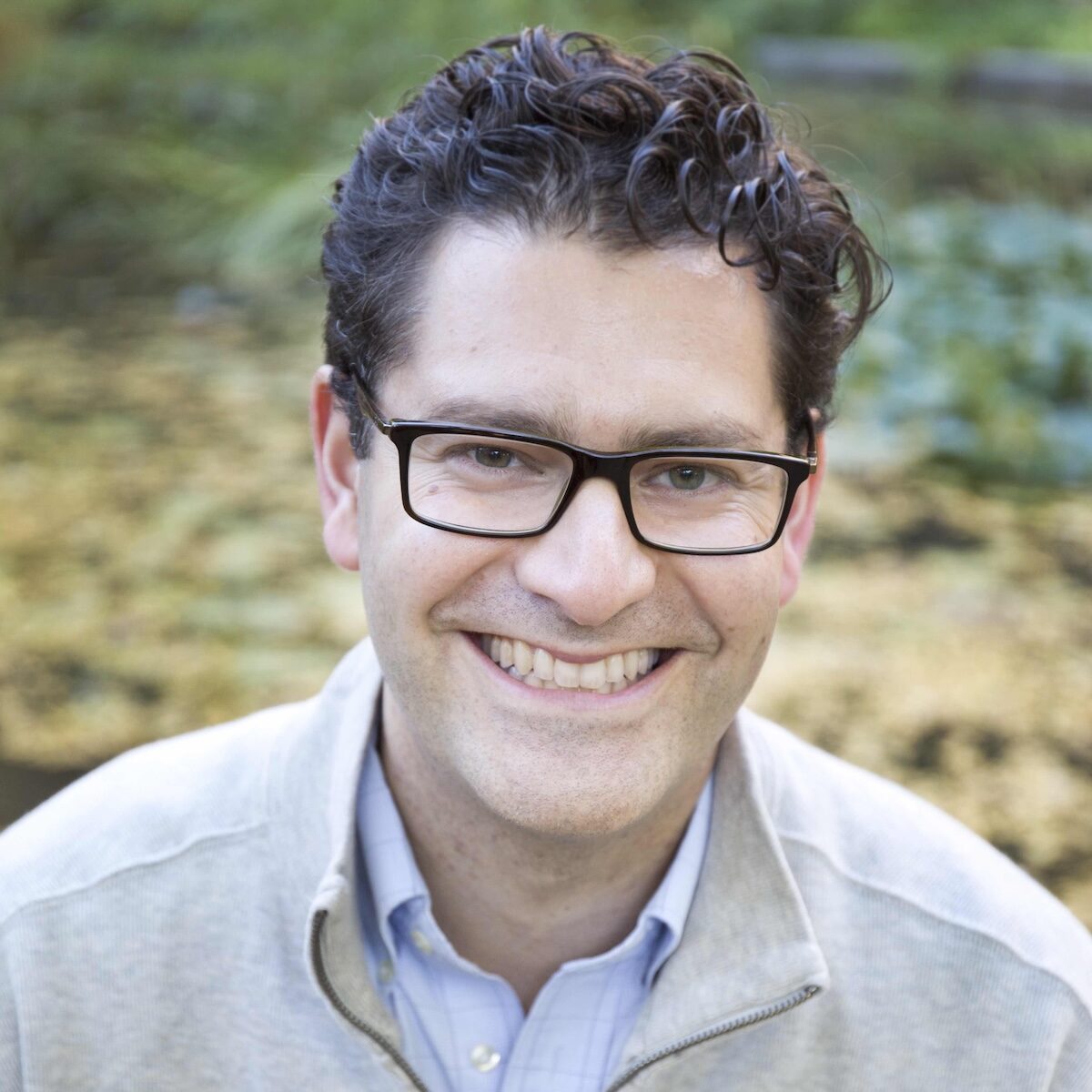
Modern life has, in many ways, removed us from the environments in which our ancestors lived and adapted. Not only do we spend time looking at screens, but we spend time indoors, or outdoors but in urban spaces. How does this affect how we think and feel? Psychologist Marc Berman is a pioneer of "environmental neuroscience." In his recent book, Nature and the Mind: The Science of How Nature Improves Cognitive, Physical, and Social Well-Being, he presents evidence that spending time in nature not only puts us in a better mood, it makes us better thinkers.
Support Mindscape on Patreon.
Marc Berman received his Ph.D. in psychology from the University of Michigan. He is currently Professor of Psychology and Faculty Co-Director of the Chicago Center for Computational Social Science at the University of Chicago. Among his awards is the American Psychological Association Distinguished Scientific Award for Early Career Contributions.
Click to Show Episode Transcript
0:00:00.4 Sean Carroll: Hello, everyone. Welcome to the Mindscape Podcast. I'm your host, Sean Carroll. Have you been told by one of the kids today to go touch grass? Or are you a kid today who has told people to go touch grass? I get the impression, I do not pretend to be up on the lingo used by the youths of the world today, but in certain circles, if you're having a conversation or interacting, usually online, and someone is trying to point out that maybe you've become a little unmoored or unhinged or unrelated to the real world, maybe it's time for you to get off the computer, go wander outside in nature, look at a tree, touch the grass, get reconnected to the natural world around you to maybe find your bearings a little bit. And the good news is there is science to back up the idea that this would actually be a clever strategy to reconnect yourself to the world, or maybe even a better way of saying it is you would become a better thinker, not just someone who is in a better mood, but you can actually use your mental capacities more effectively if you are experiencing nature in some way. At least that's the thesis being put forward in a book that came out last year by today's guest, Marc Berman. The book is called 'Nature and the Mind: The Science of How Nature Improves Cognitive, Physical, and Social Well-being'. And as we'll see, Marc has been a pioneer in an idea called environmental neuroscience, trying to judge how the brain functions differently in different contexts. One of those contexts might be, literally, you're out in nature just taking a walk or whatever. Another might be you're in your room, in an office, or at home, or in an urban environment walking around the street. Maybe it's not surprising in retrospect, but our brains seem to function better, some evidence indicates, when we're in that natural environment.
0:02:04.7 SC: After all, we did evolve in a more natural environment. We didn't have cities 100,000 years ago, and the development of technology and urbanization has been a relatively recent occurrence in human history. So there's something about, and this is the fun part of the conversation, is that we're not exactly sure what it is, but there's something about just looking at natural things, whether it's coastlines or trees or whatever, that engages our brain in a way that is restorative rather than draining. And again, it's not just about you feel good, it puts you in a good mood. You can do better on cognitive tests when you are outside or even have recently been on a walk through the woods. So as Marc wants to stress, we chatted about this after we actually recorded the podcast, it's not against cities. We both live in cities. We love cities. There's something good and important and creative about living in a city in various methods, various measures that you could quantify. But there's also something important, if you want to be at your best, to get some nature in your life. And that might be literally taking a walk in nature or even something as simple as having a window that looks out at a tree rather than out at a brick wall or out at a street.
0:03:27.6 SC: So I think it's very interesting as a hypothesis, and the evidence for it is very interesting. And as you'll see, we got derailed a couple of times during the conversation just because there's interesting physics and information theory and complexity theory that comes in when you try to figure out why is it that this kind of thing helps the brain. And as an extra treat, I'm beginning to add these extra treats more and more, we did one with Daniel Harlow a few weeks ago where we talked like physicists at the very end, here the extra treat is at the very end, Marc and I switch roles and I give Marc a little chance to do an AMA. So he's a fan of the podcast. He's listened to many other episodes, so he asks me questions for a few minutes at the end there. Why not? We've already done our work in explaining the science of his research to you. Why not have an informal chit-chat? It is a podcast, after all. There are no rules. And with that philosophy in mind, let's go.
[music]
0:04:42.1 SC: Marc Berman, welcome to the Mindscape podcast.
0:04:44.5 Marc Berman: Thanks so much for having me on the podcast, Sean. I'm a huge fan and an avid listener.
0:04:48.5 SC: Oh, great. This should be a wonderful conversation. To start, before we actually get into the specifics of what you're talking about, it reminds me of this fact that is sometimes trotted out. We all live in environments that are just changing very, very rapidly, especially compared to the timescales on which we're evolving as a species. In a very real sense, we are inheriting a genetic legacy that was put together thousands or tens of thousands or millions of years ago. And here we are. I live in a house, right? My genes are not adapted to living in a house. I've tried to build a house around it, et cetera. How do you think about this? It's not even so much a question as an observation I'd like for you to reflect on. How important is it or how dramatic is it that we should be thinking about the differences between what we grew up to be and the environments we're in right now?
0:05:44.9 MB: I think it's a great question. I think it's something we have to pay a lot of attention to. And it's kind of ironic in a sense, Sean, that even though we are living in such arbitrary kinds of environments compared to the environments that we evolved in, in some sense, because humans have so much control over the environment, I believe we think we're almost immune to it. And that's something that we've been thinking a lot in my laboratory is that we aren't immune to the environment and we're a part of the environment. I think people sometimes get this sort of feeling that humans are kind of distinct from the environment. But no, of course we're very much part of the natural world. And it's interesting that because we have so much control over the environment, it's sort of this bidirectional kind of relationship. So our brains have been shaped by the physical environment. Now our brains are designing the physical environment, and that new environment is now also shaping our brains. And like you said too, it is happening very, very rapidly. I mean, we've only lived in these cubicle boxes for a few hundreds of years. It's kind of arbitrary. And that's something that we think a lot about, that our brains sort of adapted to a very different environment.
0:06:58.6 SC: Right.
0:06:58.7 MB: And so now we're kind of in this other kind of environment, and that can have positives and negatives. And I think in my lab, what we think a lot about is, I don't want to poo-poo a lot of architecture or design, but I would say that a lot of modern architecture and design or how we build things that we live in, they haven't been designed to say, "Okay, let's make people more cooperative," or, "Let's build this environment so people have better working memory capacity or better attention." It's kind of just built to house people efficiently, move goods efficiently. So I think in my lab we're starting thinking more about this and just taking a pause and say, "Okay, we think that this kind of," I say, "artificial" environment that we kind of live in now is kind of changing our behavior, maybe changing our brains. And we need to think seriously about what that means and maybe what we can do about it or how we might want to change the environment.
0:07:53.9 SC: I mean, there's some irony there, right? Because we do have much more control over our own environments than we used to, but we don't always use that control for good. Or at least we're not always thinking at the right level about what it would mean to construct the right kind of environment.
0:08:09.0 MB: Right, exactly. And I think part of that too might be that I would say for a lot of years, maybe this would sort of be thought of as being sort of fringy kind of science, that this isn't the most hardcore, rigorous science, in part because it's really hard to do carefully controlled experiments. In an ideal world, I would love to be able to move people to different environments, manipulate different elements in some people's environments, but you can't do that easily. So it takes a lot of hard thinking and you have to sort of triangulate research from a lot of different areas to be able to draw strong conclusions.
0:08:48.8 SC: So why don't you just tell us sort of the high-level message here. And you have a book out that came out last year. So remind us the title of the book and what it's all about.
0:08:58.8 MB: Yeah. So the title of the book is called 'Nature and the Mind: The Science of How Nature Improves Cognitive, Physical, and Social Well-being'. And the book talks a lot about this field called environmental neuroscience that I kind of helped to develop, which is very interested in the bidirectional relationships between the physical environment and our brain. So again, as I kind of mentioned before, our brains have adapted to the physical environment. We as humans have a lot of control over the physical environment. So we're manipulating the physical environment. And then this environment that we've created is also impacting our brains in this kind of cyclical relationship. So in the book, I focus a lot in my lab on natural environments. So contrasting people interacting with more natural environments, like you could think about your local park or the trees on your tree-lined street, maybe you go on vacation to a lake. So interacting with those kinds of environments that have been less manipulated by humans compared to interacting with more human-made environments, cities, towns, office spaces, schools. And we find in my work that when we interact with these more natural spaces, that can actually cause changes in our attention and our working memory, that people actually show improvements in their attention and working memory after spending short amounts of time in these more natural environments versus the more urban or built environments.
0:10:38.4 SC: And I think it's important just to distinguish here because lots of people will say, "Yeah, I like spending time in nature. It relaxes me, so it puts me in a good mood." But you're less talking about mood and more about really cognitive abilities, which is a different kind of claim.
0:10:56.1 MB: Yeah, absolutely. And there had been research done. I wasn't the first person to look to see if interacting with nature had psychological benefits. There had been other studies where they had people interact with more natural environments versus more urban environments, and people reported feeling better. Maybe their mood improved, or maybe they felt like their attention was better, but they didn't use any objective measures of performance. So we did one of the first studies where we actually measured objectively people's changes in performance after interacting with these different environments. And one of the ways that we measured people's objective performance was with a task called the backwards digit span task. So that's a task where you would hear digits out loud at about one digit per second, and you would need to repeat the digits back in backwards order. So you might hear the digits 8, 3, 7, and then you need to repeat it back in backwards order, so 7, 3, 8. And we keep increasing the number of digits up to about nine digits. At around five digits, the task is very challenging.
0:12:02.9 SC: Yeah.
0:12:03.7 MB: So what we did is we gave people this difficult backwards digit span task. Then we had them go for a walk in a more natural environment or go for a walk in a more urban environment. They came back to the laboratory after the walk, and the walk was about 50 minutes. They come back to the lab, they do this backwards digit span task again, and then they come back to the lab a week later and they repeat the whole procedure again. If they walked in the natural environment the first week, they walk in the urban environment the second week, or vice versa. So everybody was their own control. It was a within-subject design. And what we found is that when people walked in the natural environment, they showed about a 20% improvement on this backwards digit span task. So they improved by like a digit and a half compared to the urban walk where they really didn't show any significant improvement. And again, a lot of listeners might be saying, well, Marc, because people probably enjoyed the nature walk more, maybe they were more motivated. And it was certainly the case that people liked the nature walk more than the urban walk. We did have mood measurements too, and we saw that, yes, mood tended to improve after walking in nature, but we didn't see a strong correlation between the improvements in mood and the improvements in this backwards digit span task. So that's okay.
0:13:23.3 MB: So it wasn't like the people that were just getting happier were the ones that were showing the most improvement in the backwards digit span task. But what I thought was a little bit more interesting is that we had participants walk at different times of the year. Some participants walked in June when it was like 80 degrees Fahrenheit. People loved the walk. They said, "Marc, I can't believe you're paying me to go for a walk in nature." Healthy mood benefits, healthy backwards digit span benefits. But we also had people walk in January when it was like 25 degrees Fahrenheit. People said, "Marc, I was freezing out there. That was not enjoyable." But the people that walked in January showed the same cognitive benefit, the same improvement on the backwards digit span task as the people that walked in June. So the takeaway message was you don't even have to enjoy the nature walk to get these cognitive benefits. You do obviously have to enjoy the nature walk to get the mood benefits, but you don't have to enjoy the nature walk to get the cognitive benefits. And I think that's interesting because that's somewhat counterintuitive, that this isn't some kind of hedonic kind of response like, "Oh, I like eating chocolate," and you eat some chocolate, you feel good. That there's something deeper going on there in terms of why or how nature might be improving people's cognitive performance.
0:14:36.2 SC: I do have to say that a lot of these psychological tests seem pretty anxiety-inducing. I would feel very bad not being able to say the digits backward.
0:14:47.3 MB: Absolutely. And we try to tell people beforehand this isn't an IQ test, but it is anxiety-provoking. And then that could also be part of the phenomenon too, that if nature is sort of relaxing us a little bit more, maybe you can perform better. And somewhat related to that, Sean, we repeated this same experiment, but this time with participants who are diagnosed with clinical depression. And clinical depression often is characterized by what's called negative rumination, that people kind of repetitively think about negative thoughts and feelings over and over again. And we kind of wondered, we actually had an NIH grant at that time to study people with depression and look for kind of working memory deficits for people with depression, and we thought, "Oh, we had this interesting result with nature. What's this gonna look like for people who are suffering from depression?" It might be that if you go for a walk alone, maybe that's going to increase rumination. It's gonna give you more opportunity to ruminate. So actually there, we took these participants who had been diagnosed with clinical depression. We did the whole same walk-in-the-park procedure that I outlined before, but this time we had people think about a negative thought or memory that was bothering them before they went on the walk. So we were sort of inducing them to ruminate beforehand, and we found even stronger results here. So again, the procedure was all within-subject.
0:16:15.1 MB: Participants walked in both nature and urban, but this time we had them ruminate about a negative thought or memory before the walk. And they showed even stronger improvements in backwards digit span performance after the nature walk relative to the urban walk. And I know this isn't really a self-help kind of podcast, but now there's actually, in the UK and in Canada, physicians are prescribing walks in nature as sort of a supplemental therapy for people suffering from depression and anxiety. So again, we're gonna dig in I think a little more about what mechanisms are going on here, but I think many of your listeners will have this idea that being in nature is sort of calming. Even if it's not improving your mood, it might be sort of calming to your nervous system.
0:17:03.0 SC: I have to get right away the question on the board, which is this is an interesting finding in psychology, and we've all been trained that interesting findings in psychology should be looked at with skepticism because there's small sample sizes, they're hard to replicate, et cetera. But this was a while ago you've been doing this. So what's the state of the art?
0:17:24.9 MB: Yeah, so I'm pretty confident in these findings, and no one has IDed this effect as being something that's not replicable. So many other labs have replicated these effects. You're right, the sample size was small, relatively small. So we had about 40 participants in that study. It was within-subjects, so that's like equal to a sample of like 80 participants between-subjects. But yeah, not millions of people, not thousands of people. There have been other studies too, outside of the laboratory, where they look at quantifying green space around people's homes and their schools and look at kids' working memory performance and how they're doing in school, and they find that children that live in neighborhoods that have more green space have better attention and working memory, even when you control for things like age, education, and income of their parents. There are some other really interesting studies that were done in public housing projects in Chicago. These are not desirable places to live.
0:18:32.8 SC: Not the greenest spaces. I've been there. Yeah.
0:18:34.9 MB: Not the greenest spaces. In fact, they've demolished many of these facilities. And what's interesting about these facilities is that the families were randomly assigned to different apartments, so it's almost like a controlled experiment. And what these researchers looked at, this was Ming Kuo and Bill Sullivan from the University of Illinois, they looked at views out of the window in these public housing projects and also quantifying, sort of with satellite imagery, how much green space was around these public housing projects. And it turns out that the apartments that had the views of nature, people had better attention in those apartments. There was lower reported crime, lower reports of aggression, again suggesting that this nature, even if it's modest, could have some salubrious qualities to people's psychological functioning.
0:19:28.4 SC: Okay, that's good to know. Yeah. I mean, you mentioned the theoretical background, which I did want to get into. I'm a physicist who always loves to say, like, experiments are not real until they're confirmed by theory. So there's something that you talk about called the attention restoration theory. Tell us what that is and how it's relevant to your studies.
0:19:48.9 MB: Yeah, so this was a theory that was codified by one of my mentors in grad school, Steve Kaplan and his wife Rachel Kaplan, who are environmental psychologists. And one of the main tenets of this theory was sort of that humans have two kinds of attention. So one kind of attention he called directed attention. Sometimes people call this top-down or endogenous attention. This is the kind of attention where you as an individual person are deciding what to pay attention to. So presumably, Sean, you're deciding to pay attention to me, your listeners are deciding to pay attention to what I'm talking about. But it's thought that that kind of attention is fatiguable or depletable, that you can only sort of control your attentional focus for a limited amount of time before you become mentally fatigued and then you can't focus anymore. And we've all had that sensation that after a long workday, 3:00, 4:00 in the afternoon, you might be staring at the computer screen and it's just hard to focus. Or I see this when I'm lecturing. I think I'm a decent lecturer, but the first five minutes of lecture I see a lot of eyes on me, people nodding along with me. 45 minutes into lecture I see a lot of students kind of tilting their head back. They're kind of dozing off. It's just hard to control your attention.
0:20:57.9 SC: Yeah.
0:20:58.5 MB: So this directed attention ability is really important because it shows that humans are not just stimulus driven. We can decide what we're gonna pay attention to, but we can really only do that for a limited amount of time before we've become mentally fatigued and we can't really do it. So when you can't really control your attention, we call that a directed attention fatigue state. That's when we think it's a good time to take a break in nature. That's different from another kind of attention that Steve called involuntary attention. Sometimes this is called bottom-up or exogenous attention. And this is the kind of attention that's automatically captured by interesting stimulation in the environment. So bright lights, loud noises, those things automatically capture our attention and we don't really have control over it. And it's thought that this involuntary attention is less susceptible to fatigue or depletion. So you don't often hear people say, "Oh, I can't look at that beautiful waterfall anymore. It's just too interesting. I'm too tired. I have to look away." Or, "Oh, I can't watch this really interesting movie anymore. It's so interesting, I'm just getting really exhausted. I have to shut it off." So the idea with attention restoration theory is that if you can find environments that don't place a lot of demands on directed attention while simultaneously having interesting stimulation to activate the involuntary attention, you could restore or replenish this precious directed attention resource. And it's thought that natural environments is one kind of environment that can do this. It doesn't mean it's the only kind of environment that can do this, but it's one kind of environment that can do this.
0:22:25.9 MB: There's one other thing that I think is important to mention too, which is we think it's important the kind of stimulation that activates this involuntary attention. So when I look at a beautiful waterfall, it captures my attention, but I can still kind of mind wander and think about other things looking at that beautiful waterfall. It doesn't capture all of my attentional resources. When I'm in Times Square in Manhattan, wow, also super interesting. Lots of stimulation to capture my attention, but it sort of does so in an all-consuming and sort of harsh way. I can't really mind wander or think about other things in Times Square. So we think the kind of stimulation that captures your involuntary attention should be softly fascinating and not harshly fascinating. And we think that's the kind of environment that's going to be able to restore our directed attention abilities.
0:23:13.0 SC: So the idea that really stands out to me here is you might have thought that attention is a finite resource, like we have a bucket full of attention and we use it up. But you're saying that some ways of paying attention do use it up, but some restore it. Even as we're paying attention, we're still gaining more ability to do so.
0:23:33.2 MB: That's right. So I do kind of think of directed attention as a bucket or a bank account that you can kind of cash out or empty, but that this is not a passive process. So it's like engaging another kind of attention that's like a Goldilocks rule. It's sort of interesting enough that it captures my attention, but not so interesting that it's all-consuming. It kind of sits at this nexus that, yes, that we think that can actually restore your directed attention. I mean, presumably sleep would do something similar, but I think often when we're mentally fatigued, we're actually not physically fatigued.
0:24:11.0 SC: Yeah.
0:24:11.3 MB: It's almost like our bodies are telling us, "Go do pay attention to something else," or you have to switch tasks. So that's the kind of fatigue that we're sort of talking about. And as you're saying too, this is sort of like an active process that can kind of restore our attention. And people sometimes ask me, "Well, Marc, what about sitting in a dark room?" And my answer to that is, no, in part for a number of reasons. So one, most people don't like sitting in dark rooms. They find it boring, and boredom is fatiguing. And again, it's back to this idea that this isn't just a completely passive process. This isn't just like sleep. This is sort of an active process of engaging maybe a different kind of attention, like involuntary attention or a different kind of attentional process that can actually refill that directed attention bucket.
0:25:08.5 SC: This might go against everything that you believe in, but for me, I think I do that by taking a break from work and playing little cheap video games on my iPad. If you find that sweet spot where the game is engrossing enough that you want to play it for a little while, but not really requiring too much effort and thought and everything, that can actually re-energize me a little bit. Is that compatible with this, or am I just weird?
0:25:35.8 MB: I think that is compatible because again, there's nothing in attention restoration theory that says it has to be nature. It only has to meet these criteria of not placing a lot of demands on directed attention and having softly fascinating stimulation to activate involuntary attention. So if these little video games do that for you, that's good. However, I would say the video games that our kids are playing out there are much different and much more engrossing, and I think that's a different kind that actually is more harshly fascinating. And we maybe will get there in this podcast, but a lot of these new technologies, I would say, are very harshly fascinating. They're designed to keep your attention and not let go, and they're addictive, and most addictions are not really good for cognitive functioning.
0:26:27.7 SC: Right. Is there a relationship here between this sort of directed and undirected attention versus System 1 and System 2 cognition that Kahneman would talk about?
0:26:37.1 MB: Yes, yes, I would say very much.
0:26:38.9 SC: For those who don't know, remind us what that is and how they might be related.
0:26:42.2 MB: Yeah, and I sometimes I get this wrong, but I think System 1 is sort of the more heuristic kind of thinking, the easier kind of thinking, and System 2 is more of the arduous kind of thinking. And so if we wanted to map this on here, we would say that involuntary attention is more like System 1 and directed attention is more like System 2.
0:27:06.9 SC: And an example came to mind when I was reading your stuff. Years ago, when cell phones first became popular, there was this controversy or whatever about driving while you were talking on your cell phone. And there was this thought that as long as you had a place to put the phone so you didn't have to actually literally pick it up, it shouldn't matter because you're still driving with your eyes and your hands and so forth. But I think, in fact, that's not true because talking on the phone is depleting your attention. Was that impression that I had correct?
0:27:41.5 MB: You have it correct. And maybe I'll spend a moment on this because I think it's really, really important. So there's actually this idea that there was this peripheral hypothesis, the problem that talking on a cell phone and driving have to do with actually physically holding the phone and maybe only having one arm to do the driving, or is it attentional, that it really doesn't have to do with holding the phone, it has to do with where your attention is directed. And it turns out it has nothing to do with holding the phone and it has everything to do with attention. And one of the examples that I like to give, especially when I'm teaching, is we've kind of all had that sensation, maybe and it's not good, but driving on the highway and you might not remember what scenery was around you for the last couple of minutes driving on the highway.
0:28:31.5 SC: Yep.
0:28:31.9 MB: Because your attention is somewhere else. You might be mind wandering. Even though the light from the road and from the environment is all hitting your retina, right, so all those signals are getting to the retina, the brain is not attending to it. So that's the difference between what people call overt attention and covert attention. So where your eyes are moving is the overt attention, but covert attention is actually really what you're paying attention to internally. And so what's the problem with the cell phone is that your covert attention is directed to the phone call, which means you're paying less attention to the road. And that's really dangerous. And that's like too, if you're driving in an unfamiliar place, typically you turn down the radio because you want all of your attention to be driving. And the problem with the cell phone, the person on the other end doesn't know...
0:29:20.1 SC: They don't know.
0:29:21.2 MB: What conditions you're in. If you've got a friend in the passenger seat, you tell them to shut up when you're in hard road conditions, but that doesn't happen with the cell phone. So you can see all these examples of lots of car accidents happening, people talking on the cell phone, even if it's hands-free.
0:29:37.7 SC: And not to be too grandiose about it, but maybe there's a lesson here for the philosophy of mind and maybe even for AI and its relationship to intelligence and consciousness, namely that we are much more than the surface level input-output machine of reading and writing or listening and talking. There's just so many layers of things going on simultaneously, all of which do indeed interact with each other and feed into that final output that we have.
0:30:08.9 MB: Absolutely. That and that's why behaviorism failed in psychology. So Skinner and Watson, they were frustrated with late 19th century psychology and maybe early 20th century psychology that was all about introspectionism, just that we just look within ourselves and report our subjective experience, that that would be enough. And they thought, you can't build a science around that. It's non-verifiable. So they went all the way to the other extreme and said, basically, we can explain all behavior and even all human behavior just mapping stimuli to responses. But that turned out to be way, way too simple. There's a lot that's happening in the mind or the brain, a lot of processing happening there, and you can't ignore it. So I think now we've kind of settled more in the middle ground to say there's so much the brain is doing, interpreting these different signals from the environment and then producing outputs, even though it's very difficult to directly measure everything that's going on in the brain.
0:31:14.2 SC: Yeah, well, that was my next question, actually, because you talk about environmental neuroscience. How much can we say, oh, there's different levels of attention or kinds of attention, associate them with different processes or even different parts of our brain?
0:31:30.7 MB: Yeah, I mean, I think we can do it, and I do a lot of neuroscience in my lab. What I'm trying to do is merge the environment with the neuroscience together, but it's challenging for a number of reasons. So I don't know how many of your listeners have been in an MRI machine, but that's, we do a lot of brain imaging in MRI machines. We call it functional MRI because we basically make a flipbook of your brain to see the dynamics. It's such an uncomfortable and arbitrary environment. It's hard to give people a nice nature experience being in the MRI scanner. There is now new technology that we're starting to use now called functional near-infrared spectroscopy, which is a little cap that people can wear. It looks kind of like an EEG cap. It shines infrared light into the brain, and then it can measure basically blood oxygenation levels in a similar way to MRI. And this is mobile. People can wear this with a little backpack, and we can have them walk in natural environments versus urban environments. And I'm interested in that. We've started to do that. I think we know a lot. The fact that we know that people's backwards digit span performance is changing after the walk in nature versus the urban walk, we know something's happening in the brain there. The question then is, okay, so what more do we need to know? Does it matter? And I think it does, but we have to think a little bit deeply.
0:32:59.3 MB: It's not gonna be satisfying if I put people in an MRI scanner and show them nature pictures versus urban pictures, I'll find differences. But what's causing the differences? There's many, many features that differ between the images. The nature images have different fractalness, different entropy, different amounts of curved edges, different color palettes. So it's hard to zero in on what's causing the differences. And then if we find those features, is that the thing that's actually causing the changes in performance? It's not clear. So I'm still, I'm very eager to bring more neuroscience in, but we have to think hard about it. We can't just do some of these little experiments that people might think about. Well, just put people in an MRI scanner, show them nature pictures versus urban pictures, look at the differences and, bada bing, bada boom, that's gonna tell us why nature's restorative. It's gonna be more complicated than that.
0:33:55.2 SC: Well, good. That was exactly, again, where I wanted to lead to next. I mean, what is it about nature versus the urban environment that is more restorative? Because you can think of lots of different things. The colors are different, the shapes are different, the sounds are different, but also the purpose is different. We have this feeling like when we're in nature, we're there to chill out a little bit. When we're in the city, we're on an errand.
0:34:20.4 MB: Right, right.
0:34:21.1 SC: So what are our thoughts about what are the salient features there?
0:34:24.6 MB: Yeah, so it's a great question, something we're really thinking a lot about. I'll back up just a little bit just to say too that we've also done studies where you can show people just pictures of nature or listen to nature sounds versus urban sounds, or watch nature videos versus urban videos and still get some of these similar changes in backwards digit span performance, which suggests to us that it's something about the perceptual features of nature that might be producing these benefits. So then that kind of gets away from it just being leisure time per se. If you're sitting in a laboratory just looking at nature images and urban images, I guess if you're looking at the nature image, maybe you're thinking about your vacation more often, but we think that's less likely and more that there's something about the stimulation there. I will go back to something you said originally about being careful about replication. These effects with the pictures and the sounds and the videos are not as strong. These effects are not as strong as going into real nature. And sometimes you get the effects and sometimes you don't. It's not quite as robust. But the fact that you can get it suggests that there is something about the perceptual qualities of nature that are producing these effects. Okay, so what are those perceptual features? We've started to become really, really interested in ideas of information and compression.
0:35:44.9 MB: So I did have a student, Omid Kardan, and we used to, he was actually an electrical engineer, and we would talk a little bit about nature images and urban images. And we wondered, maybe nature images get compressed down into fewer bits than urban images because there is a lot of repeated structure in a natural image compared to an urban image. So then a few years later, my current PhD student, Nakwon Rim, we actually tested this. So we actually took hundreds of images where we had humans rate the images for how natural they thought the images were on a scale of one to seven, with one being not very natural and a seven being very natural. And then we ran a JPEG compression style algorithm on these images. So, I'm sure a lot of your listeners know, but just to kind of reiterate, what JPEG compression does is you might have an image that's 100 megabytes, but to save room on your computer or on your phone, maybe you can remove a lot of information from that image. So you throw away a lot of information. Your eye might not be able to tell that anything has changed, but maybe you've taken this image that's 100 megabytes and now it's down to 10 megabytes. So you've saved so much room on your phone or your computer. So we ran these JPEG-style algorithms on hundreds of nature and urban images, and we did find that more natural images tended to get compressed down into fewer bits than the urban images, suggesting that there is more compression, there's more throwing away of information in nature scenes than urban scenes. And remember too, this is based, these JPEG compression algorithms were based on human visual perception, right? They work well because they've been tuned to how the human eye sees things.
0:37:45.3 SC: I didn't even know that. So it's not purely mechanical, it's tuned for humans.
0:37:49.0 MB: It's not purely mechanical, yeah, it's tuned for humans. Yeah, it's tuned for humans. Although we could ask, you had Alvy Smith here, he probably knows quite a bit more about this than I do.
0:38:01.2 SC: That's true.
0:38:02.7 MB: So that's fine, that's interesting. Then we asked this other question, which was, okay, if nature images are easier to process, maybe that might also mean that they're less memorable. And your listeners might be thinking, okay, but being less memorable sounds bad, but we think it might be good. If something is not memorable, it might mean that your brain has not exerted a lot of energy to process it. So what we wondered too is, are nature images less memorable than urban images? So we did an experiment where we show people hundreds of images that vary in how natural or urban they are, and you see these images and you basically have to respond if you see an image that's repeated, which is a measure of sort of memory. And it turns out that people do not remember the nature images as well. They remember the urban stuff better, which is also kind of consistent. And to bring these things together a bit, we find statistically that part of the reason why nature images are more forgettable is because they're more compressible.
0:39:08.9 SC: Yeah. So I'm gonna wander off the reservation a little bit here and make a suggestion or a conjecture, because what you're talking about, it sounds like it's right next to what I would have suggested, which is to think about entropy, but to think about it from the information theory perspective, not the physics thermodynamics perspective, right? Claude Shannon taught us that information comes about because you get a little bit of surprise when you get a message. If you just get the same message over and over again, you're not actually getting any information, even though you're getting a lot of symbols. Whereas if you want to convey a lot of information, you invent a code where all of the different symbols are equally unlikely so that you're learning something from every symbol. And so you can calculate the entropy of a set of messages, and the bigger it is, the broader it is, the more information it contains. And it sounds like what you're saying is right up next to saying the information input from nature is low entropy. You're sort of not surprised when you see the tree or whatever. You're expecting what to see and you don't need to do a lot of processing. Whereas in the urban environment, maybe you know that there's going to be a street and a sign and whatever, but what sign is it? You actually have to pay attention, and it's that it would be a higher entropy visual input and therefore require more processing.
0:40:35.4 MB: Yes, and I think I would agree with you. It is interesting, though, and I can't remember all the details. I know we've run grayscale entropy measurements on these images, and that, if I remember correctly, doesn't show as big of a difference as we would think. Now, I don't know why that is. Maybe we have to do something actually with the color entropy or maybe the different color channels. But yes, Sean, it is, I agree with your conjecture there. Actually, when I was reading your book, 'The Big Picture', you have a figure in there sort of about this, which I actually took in another way. And I'll explain your figure, then you correct me if I'm wrong. But the figure that you have, you have in one of your chapters, it's The Universe in a Cup of Coffee, I think is the title of that chapter. And one thing that's always bothered me a little bit is that the highest entropy image would be basically white noise. Would be the high entropy image. But as a psychologist, neuroscientist, we wouldn't think of that as being a very complex image per se. It's complex at one level, but it's got, it's just randomness, right?
0:41:44.6 SC: I know exactly what you mean. Yes.
0:41:46.5 MB: Okay. So you have a figure in the book where in the beginning, entropy and complexity are very highly correlated, but then at some point they deviate. Complexity kind of maximizes and then it starts to decay with increasing entropy, and entropy continues to rise. So this is a long, kind of circuitous route, but I think somehow, I think for an image to be restorative, I think actually it's gotta have this kind of right amount of complexity and maybe not too much entropy. And then, I don't know too, there's some relationship here too that I think has to do with ease of processing, which I think later in your chapter you talk about fractalness. Now, when I think about fractalness, fractalness is sort of like repeated structure at different kinds of scale. So natural images tend to have high fractalness because it's built from the same kind of recursive process. So you can think of a tree, and the tree structure, if we think of like a maple tree, it's somewhat sort of seen in a maple tree's leaf, the veins of that leaf that also have that same structure. So we kind of say that looking at the maple tree zoomed in or zoomed out, it's kind of got the same characteristic shape. Those kind of natural fractal patterns are ubiquitous in nature. They're not very ubiquitous in the urban environment. So you look at a city zoomed in and zoomed out, it looks very, very different than looking at a forest zoomed in or zoomed out.
0:43:18.2 MB: So there, I think there's some, and we're trying to quantify this, I think there's some ease that the brain has when there is this fractal structure where you can get the gist very quickly of a scene just maybe looking in or out, you know what's going on. But in an urban scene, you can't get it as much. So I think that's kind of more where we've been thinking about how to try to quantify these things. So maybe, which I think is somewhat related to compression, but it also might have to do with this fractal structure. And it's not, again, I'm not a fractal structure expert or I'm not a fractal geometry expert. It's actually not trivial to actually find the right way to measure this. But that's something else that we've been very, very interested in is saying, okay, well, maybe it's something about this fractal structure of nature that also makes it easier to process, but then maybe you might not remember it as well. Another thing that, sorry, another thing that might be interesting to think about too is also our language. We don't really have a language of nature like we do for the urban environment. If I go and see a forest, I might say trees, shrubs, grass. It's not very semantically complex. If I go into a city, I might say Volkswagen, Toyota, BMW, Gothic architecture, stop sign. There's just so many more objects and so much more semantic complexity that also might make it harder to process, but maybe also easier to remember.
0:44:49.7 SC: Yeah, I think this is, I'm gonna start biting my tongue just because we should talk offline a little bit because there's too much to say. But this whole idea that it is relatively straightforward to invent quantitative measures that are small for perfect order and large for perfect disorder, but that's not what you want, right? Like you want something that actually peaks in between. That's a whole full employment for complexity theorists to invent different ways to do that. Logical depth is one idea that I think is very relevant here.
0:45:24.2 MB: Thank you for saying that because...
0:45:27.5 SC: It's a classic problem. But, yeah, so it's great that you're suggesting. So if I can rephrase it, see if I got it. I mean, you're suggesting that somehow, just as with the people who are trying to capture the complexity of these strings or these images, if you just do the simplest thing of algorithmic complexity, if you have a very long string of random numbers, that's high complexity in the sense that the best way to print it out is just to print it out, right? There's no secret algorithm that saves you room or anything like that. But that's also not very helpful just to print out the whole thing. And so what you're doing is you're suggesting that when there is some kind of structure, there's something going on that is interesting, that is more than just perfect order, but there's also structure that the brain can sort of latch onto and therefore not fret too much about every detail separately. Maybe that's our happy place. Maybe that is what we evolved to do back in the environment we were in before.
0:46:30.9 MB: It's possible. And also, Sean, too, it's a little more complicated because I think if we showed people perfect statistical fractals, like a Sierpinski triangle, I don't think we'd see restoration because that would be too boring. In some sense, it's too perfect. And so you've had Karl Friston on the show and Tom Griffiths talking about Bayesian models of the brain, and I think, again, there's this nexus where the brain likes predictability, but maybe not perfect. There's something interesting when something deviates a little bit, not too much, because it's satisfying when the prediction is right, but having a little bit of jitter around that prediction can be good. And it seems like maybe, I'm speculating here, but it seems like a lot of natural stimulation might kind of have that, where you imagine walking in nature and there's like a curve in the path. You don't know exactly what's behind that curve, and there's something interesting about that that captures attention, we think, in this kind of softly fascinating way.
0:47:36.2 SC: It makes me think that psychology is not finished yet. You don't have the theory of everything right around the corner. There's still a lot of work to be done.
0:47:43.7 MB: Absolutely. And you've had other guests, Tom just wrote that book, 'The Laws of Thought'. You had another guest on who wrote the book, 'A Theory for Everyone'. No, we don't have it yet. And that's why I joke with Luís Bettencourt, who's an SFI person, and Andrew, who was an SFI postdoc, one of my former students, that I kind of want, I have this desire, can we make psychology more like physics? But it's very challenging. It's very difficult. But it's like a dream of mine to get these kind of law-like formulas or even... We don't have concepts like even defining mental energy is not trivial, very complicated. So we're lacking those kinds of principles that a field like physics has and then you can do so much more with. And you can just dream that if in psychology we had that, we could do so much more in psychology and neuroscience, but we're certainly not there yet.
0:48:44.7 SC: Nevertheless, I'm gonna ask you to do one more sort of crazy speculative thing because you talk about in the book, I'm sorry, I looked at some papers and your book, so I don't know which is in the book and which is in the papers and whatever, but there are debates in neuroscience communities about criticality in the brain and power law, scale-free behavior and things like that. And it all gets very heated in a way that seems a little weird to me as an outsider because they're fitting curves and arguing about is it a perfect fit everywhere or is it just a pretty good fit in many places? But do you think that there is any hay to be made out of whether or not structures and behaviors in the brain having similar architectures to what we see when we're out in nature can play a role in this restorative aspect?
0:49:37.1 MB: Absolutely. So this is something I'm really, really excited about. So I'll take us on a little detour. So I also, I'm a neuroscientist too, and I became really, really interested in this idea of how do we quantify mental effort or cognitive effort. And with some colleagues of mine, this is when I was a postdoc at the University of Toronto, I was working with this grad student there, Nathan Churchill, and he was doing some interesting things with nonlinear dynamics. And we thought it'd be kind of interesting to apply some of these measures to some of these different data sets that we had in the laboratory. And I had mentioned to you this idea of fractalness in space, but you can also think about fractalness in time. So you can have a time series. Maybe you're measuring one voxel in the brain and you're measuring its activity level over time, and you can also sort of try to measure how fractal or scale-free that signal is in time. So basically that's sort of asking the question, okay, if you look at the signal at one second, 10 seconds, 60 seconds, 2 hours, does that signal have the same characteristics? And one of the way when we talk about same characteristics here is sort of converting that signal into the frequency domain and looking at its power spectra. And it's thought that signals that show power that's proportional to one over frequency, this 1/f kind of shape, that that sort of maybe suggests a signal that has this sort of repeated structure.
0:51:25.1 MB: And so what we did is, and sort of the perfect thing to get a little bit more in the weeds here, it's power is proportional to 1 over f to the H, where H is this thing called the Hurst exponent. And when H equals one, people say, okay, that signal is perfectly fractal in time. So what we did is we basically measured how fractal people's brains were when they were doing different cognitive tasks. So when people were doing a really easy task, or even no task at all, like just sitting at rest or doing a very easy task versus a very hard task, we found that the signal when people were doing a very hard task was much less fractal than when they were doing the easy task. So it seemed like the brain deviated from this 1/f or f to the one power, to have a Hurst exponent of one. It deviated from that when you were doing something difficult.
0:52:27.0 SC: Sorry, when you were doing something difficult or doing something easy?
0:52:30.0 MB: Difficult.
0:52:30.4 SC: It deviated from that when you're doing something difficult. Okay.
0:52:33.5 MB: Right. So it's less fractal. Like the Hurst exponent, instead of being one, would be like 0.7 or something like that.
0:52:41.2 SC: I mean, is it too cheeky to sort of conceptualize that as we're sort of focusing all of our energies on one?
0:52:46.9 MB: Yeah, exactly. Exactly. Yeah. And maybe some frequency dominates, maybe some frequency that's characteristic of whatever task people were doing. And then we saw this for other things too. Like, this is a little bit depressing, but you could have older and younger adults, and you've titrated the task that they're both having equal performance. So they're both 80% accuracy on the task. The older adults, their brains are less fractal than...
0:53:13.6 SC: Yeah, I'm not surprised by that, right?
0:53:15.3 MB: Than the younger adults. People who are under distress, they've just been told that they have breast cancer. The brain is less fractal than people who are same age but don't have that kind of diagnosis. And what's really, really interesting, this is getting a little bit nerdy. FMRI, this is all measured with fMRI, and fMRI is a slow signal, maybe 1 Hz, one cycle per second. There's also EEG, which is another kind of neuroimaging technology that we have. It's got much, much higher temporal resolution. So it can measure things up to like 50 Hz or 75 Hz even. It's got really bad spatial resolution. So you know something's happening, you don't know exactly where in the brain it's happening. I've got colleagues at UChicago, Awh and Ed Vogel. They use a lot of EEG, and they're very interested in using EEG signals to quantify how many things people have in working memory. And what they do that, one of the ways they do that is actually they find that alpha power, which is like 7 to 12 Hz, that actually tells you how many things people have in working memory. So when alpha power is lower, there's not much in working memory. As alpha power starts to increase, there's more things in working memory. And actually the direction there might be a little bit off because EEG, they sometimes flip the polarity, so negative sometimes is positive. But just take it to mean the changes in alpha power track how many items people have in working memory.
0:55:02.6 MB: Okay. One thing that they have that's really interesting is that they do these tasks where you're shown squares on the screen, like four squares, and the squares are colored, and they flash it very quick at like 200 milliseconds, and then they flash the screen again, and maybe one of the squares, the color has changed, and you need to report whether a change has occurred or not. The task is much easier to do when you're only looking at one square versus looking at three squares, four squares, six squares. But they've identified that humans really have a working memory capacity of about three items. You can't really, if you show people more than three or four squares, they can't grab anymore, their performance falls off. So here's what's interesting. So in their task, let's say they show you six items versus three items. In both cases, you can only really remember three items. So it doesn't matter doing three items out of three or three items out of six, your performance is gonna be the same. You can only grab three items. But with our Hurst measure, we can distinguish those two. We can tell if somebody is trying to remember three things out of three or three things out of six because the Hurst exponent, the fractalness of the signal, is actually less fractal trying to remember three things out of six versus three things out of three. So this befuddles them a little bit because it seems like fruitless effort. You can't grab that fourth item, but it seems like people are trying harder. So that's kind of interesting.
0:56:46.8 SC: Sorry, when you say you can tell, you mean by looking at the EEG?
0:56:51.0 MB: Yes, by looking at the EEG and looking at how fractal the signal is. We can distinguish trials when people are trying to remember three things out of three versus as many as they can out of six, but they can only really remember three out of six.
0:57:04.8 SC: There's some deep lesson there that I don't even want to draw out right now. But I mean, maybe this is the right place to go to the maybe not deep lessons, but important lessons. So okay, it's fun to conjecture and theorize about what's going on in the brain, how to explain it, but there's this still empirical finding that our attention is restored rather than depleted when we're interacting with nature in some way rather than with an urban environment. What can we do with that? What are the implications of this? Psychology matters for human life, so does this have therapeutic value? Does this have impacts for how we should design our urban environments?
0:57:47.2 MB: Absolutely. It's got wide-ranging implications. There was another classic study done by Roger Ulrich in the 1980s where he looked at recovery from gallbladder surgery. And then in the '80s, gallbladder surgery was not an inpatient surgery. You had to stay... Or not, sorry, wasn't an outpatient surgery. You had to stay at the hospital to recover. And on this single hospital corridor in this hospital in Philadelphia, patients are in different rooms. And some of the rooms have a window to nature, modest nature, like some trees and some grass. Other rooms have a view of a brick wall, like the hospital kind of folding back around. And what Roger was interested in was looking at recovery time from gallbladder surgery. And what he found is that patients recovered about a day faster if they had the view of nature out of their hospital window, and they used less pain medication compared to the patients that had the view of the brick wall. And again, this was sort of a quasi-experiment because patients didn't get to pick what room they were in. They were just kind of randomly assigned to whatever room was available. But it had this really significant impact on physical recovery, which is kind of wild. And I don't think this had to do with air quality. I don't think the patients that had the room with the nature were exercising more. There was something about the aesthetic of nature that maybe had these healing qualities. And maybe this was also somewhat mood-related. Maybe having the nature elevated mood, which had healing properties. Sean, this is almost... You could do another podcast about this.
0:59:30.6 MB: So I think there's tons of implications here, tons of things that we can do. But I would say psychology as a science has not had as large of an impact on society as you would want. Economics has. Economics as a social science has had a really, really profound impact on society, but psychology really hasn't gotten there yet. And I think there's a number of reasons why for that. One is that I think to really make hay in society, you have to talk in terms that people can really grab onto, which I think are economics. It's difficult for me to say now, what does a 20% improvement in backwards digit span mean economically? I don't know. I mean, I think people will be more productive at work, but I don't know how much more productive at work they'll be. They know that kids are gonna be more productive at school and have less behavioral issues if there's more green space around the school. But is it worth it? Because these things are not inexpensive. I mean, they're not so expensive, but they're not inexpensive. So I think we need, as a field, we need to really quantify these things more in ways that I think a policymaker could really take them and do something with it. Roger's study in the hospital did have impact. People do design hospitals, I think, trying to incorporate more nature into hospitals or around hospitals. But I would say in a large part, and this is something we're fighting against, that people view nature as an amenity and not a necessity. So they say, "Oh, that's nice if we had enough money," or, "Oh, that's for rich people. We don't all need to have this." And I think we're trying to make the argument that actually, no, this is kind of a necessity, that maybe to achieve human flourishing, to be our best selves, we need to incorporate more of these natural elements into our lives. But how much? What kind? I think these are still issues that we need to really, really work through and quantify.
1:01:36.3 SC: And also I wonder, going back to the fractals or whatever, these are, I know, sort of conjectural at the moment, but is it literal nature that is the helpful thing? Or are there just aspects of nature that we could incorporate into office design or apartment design, et cetera, that would get us some of the same benefits?
1:01:58.9 MB: I think it's sort of a staircase. So I would say nothing beats the real nature. And as I said before, when we do the studies with the simulations of nature, the pictures and the sounds, you can get effects, but they're not as strong as the real thing. Windows or views to nature can be good, but it's not quite as good as being out in real nature. Pictures of nature can work. Even having fake plants, people have found that can be beneficial. Maybe designing with the textures of nature. So as I said, mimicking patterns of nature without there actually being nature could have benefits too. So it's like, if you can't get out into real nature, can you look at real nature? And if you can't look at real nature, can you bring some real nature inside? If you can't bring real nature inside, can you look at simulations of nature? So I kind of look at it as a staircase like that. And I would hope that we're trying to kind of make this be a more serious and important issue that we really have to think about this. And it kind of goes back to the very first thing that we were talking about, which is that humans underestimate how much the physical environment impacts their behavior, impacts their cognition, in part because we have so much control over it. And I think we need to imagine we took that control and we really designed buildings and cities and towns and schools with this in mind. I think it could have profound consequences.
1:03:28.1 SC: We're not that far from thinking that we're just brains in vats or we can upload ourselves. But it seems to me, just from talking to random people on the podcast, not completely random, there's all sorts of ways, the whole embodied cognition, the extended cognition theses. It's changing very rapidly now with AI, but we're really... There are tendrils of the environment that reach into us and vice versa in crucial ways.
1:03:56.8 MB: Yeah, absolutely. So I think it's folly to ignore it. But it's, again, it's not trivial to make the case and to really take it seriously. And I don't want to be... If somebody really asked me today, "Okay, so Marc, design this school that will optimize kids' attention and working memory," I think I would have some ideas, but I would feel a little uncomfortable because I'm not sure I would know exactly how to do it correctly. I do believe having more green space around, letting the kids go out and actually use the green space, bringing some green space in, having natural patterns on the walls or on the floors, I do think all those things would produce benefits. But it'd be hard for me if you said, "Okay, Marc, here's $20 million. Is it worth it to do that versus doing something else?" That's where I think I would feel a little bit uncomfortable and I'd want to know more to be able to make that decision where I'd have more confidence. I have confidence it'll work. Is it worth that much? That's the part that I don't know yet.
1:05:09.0 SC: Yeah. Well, like we said, psychology's not done yet. I think that's the exciting part of it.
1:05:13.6 MB: Yes.
1:05:14.3 SC: Okay. I wanted to... We chatted before at the beginning of the podcast, before we started recording, that you had questions for me based on previous podcasts and things like that. I wanted to give you a chance to ask these questions. I think this is the least I could do.
1:05:30.0 MB: Great. Yeah, so I've got a number of them. I guess, okay, this one might be too similar. Maybe I should have googled this one beforehand. But when you were talking about many worlds, you did say that it's silly to think about the amount of energy that many worlds would take up, that that's not a good argument. Could you just explain why that is or why that's a bad argument to think about, "Oh, that would just take so much energy"?
1:05:58.7 SC: I have really struggled to explain this one. This is a classic question. I get it. It's a very, very good question. But it's one of the very rare questions that if you know what the equations are saying, there is not a question. The equations are just perfectly transparent, and the only question is how to translate it into natural English speech, right? I think the best I can do is to say that when you say that you're making another universe by doing a quantum measurement or something, in a sense, and then this is where all the difficulty is hidden, right? Like, what sense is it? But in a very real sense, you're not doubling the size of the universe. You're taking a universe you had before and you're dividing it in two, right? You're slicing it into copies that are almost exactly the same, but not quite the same. And so what happens when you have yourself, but also the Earth and the sun, and maybe you have some dumbbells in the gym that you're gonna lift up and you say, "Well, this dumbbell seems just as heavy as it was before I made this quantum measurement." The point is that both you and the dumbbell and the Earth and its gravitational field, they've all been sliced by exactly the same amount, right? They've all been diminished in some sense in the whole wave function of the universe by the same amount. And there is less overall energy in the universe now, but there are more universes. But relative to each other, there's the same amount as there always was, right? The Earth and the dumbbell and you all have the same relative amounts of energy. So even though the whole universe has half the energy it did, as far as your visible world is concerned, it's completely unnoticeable to you because you're embedded inside.
1:07:50.4 MB: Got it.
1:07:51.0 SC: That's the best I can do.
1:07:52.0 MB: Okay, great. Okay, here's another one, which I'm gonna start spitballing a little bit. So I've become a little bit... It's become a little of a pet project and huge interest of mine, this concept of free will and consciousness a bit. And it's kind of interesting to me that it seems like physicists are very easy to dismiss free will, but that consciousness is more mysterious or something, or it has almost more interest. And it's funny to me as a psychologist, I think just the opposite. It's like consciousness is not that interesting to me. It's like, yes, we have... Maybe that's because we're studying people all day long, but it's like, yes, we have this conscious experience. That's not interesting. The free will bit is a bit more interesting to me because it brings up these existential ideas. Well, if we're really not in control and things are just following Schrödinger's equation and we're just going along with it, it almost seems like, what's the point? Why would we have a universe like that that's just following all of Schrödinger's laws like that? And I'm an environmental neuroscientist. I'm very open to the idea that so much of our behavior is determined by other factors, that so many things are impacting our decisions. But it's strange. We all feel this such a strong sensation that we're choosing what we're doing. And it's also interesting, too, we don't have this Dr. Strangelove sensation where it's like, "I want to do this, but the universe is not letting me do it." It's astounding if we had no free will and yet somehow we're always picking or doing the things that are sort of consistent with our desires and our wants.
1:09:43.9 MB: So that's kind of interesting. And then the other thing I'll say is I do think of free will as sort of being this emergent property. So it's not like everything at the quantum level has to fully, I might be saying this wrong, it doesn't have to fully explain... Maybe that's not the right word. Maybe everything at the quantum level does fully explain, but you might have this... I don't know what the right word is, but it's like... Okay, maybe I'll just say that everything in the quantum level doesn't have to fully explain this aggregate complex idea. But you had David Krakauer on the podcast who basically said, "Don't... That emergence, you can't use that as like a get out of jail free card and just apply it to everything that you want to be true." "Oh, it's a complex system." So that sort of bit me, although it seems to me like a concept like free will or choice or decision making is a pretty emergent process. And then another thing that I've been thinking about with this too is that what is it when we're trying to make a hard decision? Like, again, if everything was so determined and we were just this input-output device, it would seem like you wouldn't have to do deliberation. The Schrödinger equation, it would just solve it and you wouldn't have this deliberation. But when I'm deciding, "Do I want to have salmon for dinner or spaghetti?" why is there this time delay if everything was just sort of determined? So that's another thing I've been kind of ruminating about a bit.
1:11:12.2 SC: Yeah, I think that for me, and I don't think that physicists as a group have a take on this, to be perfectly honest, because they've trained themselves for many years not to think about questions like free will and consciousness. There's only a few who've wandered off, and we've lost them, but most of them just... They don't want to think about the foundations of quantum mechanics, and they don't want to think about consciousness, and they don't want to think about free will. But for me, there's a very close connection between why I think that I don't understand at the detailed level how to account for free will or consciousness, but I have a strong conviction that whatever that account will be will be 100% physical, right?
1:11:54.7 MB: Oh, I'm in 100... I'm 100% in agreement with you. I'm 100% in agreement with you.
1:11:59.3 SC: Right, exactly. And I do think that, reluctance to invoke magic aside, they will be emergent because they're not fundamental. Nowhere in the standard model are there consciousness and free will. So that's enough to convince me that that's the framework to work in, even though many, many of the details still have to be worked out. That's why it surprised me when I was talking to Christian List, who did, I thought, a wonderful job of doing a much more detailed examination than I had ever done about what it means to say that free will is emergent, right? Like, what are the ingredients you need? Here's the list. Here's how you sort of connect this wish list to what is going on in the brain or the person or whatever. And then I said, "Yeah, so it's kind of like consciousness in that way." And he goes, "Actually, no, I'm not a physicalist about consciousness." And I was like, "Wait, what? It's the same road that you're walking down." I mean, it's logically possible. He clearly is, like any good philosopher, going to sometimes convince themselves of counterintuitive things because they try to think through things and make them all compatible. They just don't... They don't start with the answer and work backwards. So I thought that was very interesting, but it didn't change my own view whatsoever that ultimately it will be explained as an emergent phenomenon, and that's just all the work is to connect all the different layers together.
1:13:24.8 MB: Yeah. One thing I do wonder too, with this free will element is, is there this conflation between determinism and causality? That I think there are causes to my choices and stuff like that. I guess that's the part that would bother me the most, that it's like completely predetermined. That would be the thing that... I don't know. That's the part that maybe, maybe just...
1:13:49.1 SC: There is an old joke, I think it was John Searle who told the joke about people who don't believe in free will. Because he basically said what you said, like, when I go to a restaurant, should I just say, when they ask me what I want, should I just say, "Just give me whatever the universe has determined I'm going to have," right? Like, I don't have any choice on it. To me, there's not even a very closed door to push against here. I think that it's just confusing two different levels of description. Like, at the microscopic level, everything might be determined. Of course it's not, because there's quantum mechanics, and that's a constant footnote to throw in there, but it's still mechanistic, right? Like, even though quantum measurement outcomes are not determined, they're also not created by our willpower or something like that, right? They're just obeying the laws of physics, even though they're not deterministic.
1:14:38.8 MB: Right. That's right.
1:14:40.3 SC: But the language that we use to describe people and choices and desires and goals and so forth, that's almost inescapable. I don't know anyone, I've said this many times, I don't know any hard determinist, anti-free-will person who doesn't, as soon as they stop talking about free will, instantly use the ordinary, everyday language of making choices and thinking through and having reasons for making your choices and assigning responsibility for doing bad things, right? So, I mean, it's not that you should deny any of those. You just have to figure out how they're all compatible, and I think that that's doable. I mean, maybe we're determined, but I don't know what the determination is, so who cares? It doesn't matter to me.
1:15:27.0 MB: Yeah. I just... Something tells me that's too simple of a universe, or that's too simple. I don't know. Again, I don't have a good argument. I mean, I've been reading Hofstadter's book too, 'I Am a Strange Loop', which is kind of interesting too. It's like, yes, the atoms are all determined, but then I'm doing stuff which is moving the atoms around, so it's complicated. Again, maybe that doesn't get you to the free will that maybe somebody like Penrose wants.
1:15:57.1 SC: But it does get you somewhere, by the way. My colleague Jenann Ismael is the world's expert at this. She's really explained at a very careful level how not only can we not predict the future because there's too much information in the world, we can't be Laplace's demon because the world is just too big, but also because we're in the universe. And it's just very easy to come up with ways that you can literally interfere with what's happening. Like, if you modeled the universe and you predicted that one thing would happen, you could then do things to prevent it from happening. And that prevents you from ever completely predicting what's going to happen in the future. I think to me, it strikes me as a little bit of a technicality where free will is concerned, because I don't even have all the information. But still, it's yet another reminder that we're not Laplace's demon, nor will we ever be.
1:16:51.0 MB: Right. That was Jenann Ismael?
1:16:53.4 SC: Yes.
1:16:53.9 MB: Yeah. Okay. I think Andrew's talked to her too.
1:16:56.5 SC: Jenann, yeah.
1:16:58.3 MB: Yeah. Right. But then a guy like Penrose wants to say, "No, the brain's a quantum computer," so it's changing... So I don't know if I quite understand exactly what he's saying, but it's changing the fundamental level. So then he's saying Schrödinger's equation cannot just tell me how my brain activity's going to unfold because it's manipulating...
1:17:28.2 SC: That's right. I mean, Penrose... It's interesting to me because what Penrose actually says is sort of interesting and completely unconvincing to me.
1:17:38.0 MB: Yeah.
1:17:38.1 SC: But also people, including I think Penrose, relate it to consciousness, but it kind of doesn't even relate to consciousness. It's really just about how the brain works. And it still doesn't help you if you're concerned with the hard problem of consciousness. Like, what is it like to have these internal experiences? Then whether a certain quantum effect is happening in your brain, I don't see how that helps with that at all. Penrose is concerned with cognition. He thinks that human beings have the ability to reach conclusions that computers don't. And that's where he gets quantum mechanics into the game, et cetera.
1:18:18.4 MB: I see.
1:18:18.7 SC: And none of that has to do with consciousness, as far as I can tell.
1:18:22.7 MB: I see.
1:18:23.0 SC: So I'm both unconvinced by it and pretty convinced that it doesn't relate to the problem that people relate it to.
1:18:28.3 MB: Got it, got it, got it. So Penrose would say you couldn't have an AI that would become conscious or something like that? There's something...
1:18:35.0 SC: I think that's right.
1:18:36.8 MB: Okay.
1:18:38.0 SC: I'm actually... Certainly he would say it's harder than you think. Yeah, I actually have never asked him exactly that question, but yeah.
1:18:45.8 MB: Okay. Whereas I think that's totally on the table.
1:18:49.3 SC: Yeah, well, I think it's on the table, but one of the... So one of the disagreements that someone like me has with Penrose is he really puts a lot of emphasis on Gödel's incompleteness theorem.
1:18:59.9 MB: Yes, that's right.
1:19:00.9 SC: So Gödel comes along and says if I have a sufficiently powerful formal system, roughly speaking, if the system is itself internally consistent, which, by the way, I can never prove that it's internally consistent, but if it is, then there will always be statements that are unprovable but true in that system. I mean, basically statements that are analogous to "I cannot be proven in this system." Right? So it's true, but it's unprovable. And so Penrose says, therefore there are truths that cannot be reached by calculation or computation. And the response to that is, well, wait a minute, that assumed that you knew that the system was internally consistent. And Penrose says, "Yes, but I do know that." And the rest of us are like, "How do you know that?" And how do you know that you're working with, anyway, in a certain set of assumptions about Turing machines and things like that? So I think that he's just taking a little bit too literally the rules of mathematics and logic and applying them to the brain and therefore reaching very far-sweeping conclusions about how the brain must be working.
1:20:15.5 MB: Right. Got it. So then, yeah, can you, Sean, tell me a little bit more about, so if consciousness and free will is an emergent property, does that mean that the quantum level can fully explain it or can't fully explain it?
1:20:33.6 SC: Well, sadly, the word "explain" is doing a lot of heavy lifting there, right? I think "is consistent with" is the best you can say. So philosophers invented the word "supervenience" to handle this question because...
1:20:50.5 MB: Oh, yeah, you were using that a lot with Christian, I think, supervenience is the word.
1:20:52.9 SC: Yeah, so supervenience comes up. It's actually fallen out of favor a little bit. They've moved on to grounding and other things. That's okay. There's fads in philosophy just like every other field of endeavor. But the idea is, look, I want to believe... Let's say I want to believe that there's a sort of lower-level microscopic description and there's a higher-level emergent description. And people will argue till they're blue in the face about can you derive the higher-level description from the lower-level one. And some people will say, well, there's certain cases where I certainly can, and therefore the ones where I can't, I just haven't worked hard enough, I haven't been clever enough yet. Other people will say there are cases where even in principle I couldn't derive it no matter how hard I tried, but it is nevertheless there. And it's hard to prove that you can't derive something. That's a hard claim to make. But so the idea of supervenience was like, even if I can't derive the relationship between the higher level and the lower level, I can still specify what it means for them to be compatible, which is that I can't imagine two different situations at the higher level which are the same situation at the lower level.
1:22:06.8 SC: Supervenience is I can't change the higher without also having a difference at the lower level. Like even if I don't know exactly what the relationship is, there's that strong of a relationship. And so I think that something like that is true for quantum mechanics and the world of our everyday experience. That I don't know how to... I don't know how to explain lots of things. I don't know how to explain how the table in front of me is solid, right? Like, you want to ask me to calculate the boiling point of water. Like, I have friends who can do that, but I can't do it. But it's doable. I'm 100% convinced it's doable. And I think the same thing is true for all of human behavior, too. I have no idea how to do it. No one else has any idea how to do it. I still am convinced it's doable.
1:22:51.0 MB: Yeah. Yeah. Did you read Sapolsky's book 'Determined'?
1:22:56.4 SC: I did. I had him on the podcast as we know.
1:22:59.5 MB: Okay.
1:23:00.2 SC: And after I had him on the podcast, it was... I had him on the podcast before the book came out.
1:23:06.2 MB: Okay.
1:23:07.7 SC: And he actually emailed me a couple of chapters to read and comment on. And I just thought that they were bad. I mean, the psychology parts of the book are fine, but the philosophy parts are not that good because he can't wrap his brain around the idea of compatibilism. Compatibilism is the idea that determinism at the lower level is compatible with our conception of free will. And he tries to argue against that by saying that the lower level is really deterministic. And everyone else is like, but we're compatible with that. Like, that's the whole idea. You can't argue against compatibilism by arguing for determinism. That's just a misunderstanding.
1:23:51.6 MB: Got it. Yeah, interesting. Yeah, there was even some things when he was talking about the Libet experiments, you could predict what they were gonna choose before they choose it. That didn't... To me, even that doesn't... You can't negate free will even from that either. Like, just consciousness might be delayed, but you had some other process that really did the choosing.
1:24:13.4 SC: Well, also, again, a compatibilist does think that what we call free will and making choices and stuff like that is all a higher-level collective behavior that comes out of real physical things happening in the brain. So an experiment that illuminates what those real physical things are is in no sense a rejection of the compatibilist point of view.
1:24:40.0 MB: Right, right. But then I think when you had Christof Koch on, is he a dualist?
1:24:49.1 SC: He's certainly dualist-curious, I think. Yes. I think he's moved in that direction over the years. Panpsychism, he's very comfortable referring to himself as a panpsychist, but I don't... There are all these, like, splitter kind of distinctions that I can't always keep track of. So you can be a panpsychist without being a dualist. You can be sort of a monist who thinks that the monism stuff is mind, not physical reality. So like mind comes first and the physical world is just a projection of that in some way that I fail to quite wrap my own brain around. But so, yeah, I cannot quite...
1:25:30.1 MB: But then, yeah, how would they explain what was the universe before there were humans?
1:25:35.0 SC: There was mind, but it wasn't human mind. There's a little bit of mind in every particle.
1:25:41.2 MB: Okay, right. Then okay, that's the panpsychism. Yeah.
1:25:45.8 SC: Yes.
1:25:47.7 MB: Yeah, I love how you talk about Copenhagen too, 'cause that always really bothered me about that you need this observer. It just seemed to always bother me.
1:25:56.3 SC: Yeah, and it's remarkable it's still the most popular way of thinking about quantum mechanics among physicists.
1:26:03.0 MB: That's interesting. I mean, the hard part for me is just Many-Worlds is also hard to digest. I don't understand it, but it's difficult. And how come we can't, again, 'cause my knowledge is too naive, but you'd think we'd be able to detect some of those other worlds somehow or something.
1:26:23.0 SC: There's good explanations for why we can't, but I think I'm absolutely sympathetic to people who find Many-Worlds hard to swallow. But it's hard to swallow because it's really asking a lot of us sort of metaphysically. Copenhagen is hard to swallow because it's not well-defined. I think that to me, that's a much more fatal blow than just asking a lot of the listener. Yeah.
1:26:44.6 MB: Right, right. Could free will have any or choices have anything that plays into Many-Worlds, or would that be kind of crazy?
1:26:52.0 SC: So, my opinion on this has changed by a tiny, tiny amount in recent months. The short answer is no, because you're not saying in Many-Worlds that you're creating a whole 'nother world by making a decision. You're saying that a quantum system that was in a superposition becoming entangled with its environment is making another world. I know that sounds much less sexy, but that is actually what is going on. But the other way around could be true. In other words, it's not that decisions branch the universe, but when the universe branches, that could be interpreted to us as making a decision, right? In other words, things happen in our brain, and it's possible, it's conceivable, and I honestly don't know the answer, it's conceivable that if you're making a difficult decision, if you truly don't know which way you're going to go, that there ends up being a substantial quantum mechanical probability to go one way or the other, right? 'Cause there's small quantum fluctuations in your brain rather than just all averaging out, which is what you might expect. There's part of the brain behavior that is chaotic, right, and which amplifies tiny little fluctuations. And so maybe, maybe that's a possibility. And so that would still not say that your decisions are making the universe branch, but it would say that when you make a difficult decision, there is another branch of the wave function of the universe where you made the other one, which I think is an interesting thing to think about.
1:28:25.5 MB: Right. Yeah. Super, super interesting.
1:28:30.1 SC: I hope that was, yeah, I'm glad whenever we can all agree that all of these things are interesting and mixed up together and we should all talk about them, even though academia doesn't always encourage us to do that.
1:28:41.6 MB: No, no, for sure. And Sean, I hope it's okay if I bug you again sometime, 'cause I've been thinking a lot about this and I don't have it all wrapped around. I did have a good talk with James Evans. He's like, "Oh, we should write an article about this." I'm like, "We would need somebody like Sean to help us."
1:28:56.0 SC: That sounds good to me. You know where to find me.
1:28:58.1 MB: Okay.
1:29:00.6 SC: All right, Marc, I hope everyone buys your book. And I hope, I'm gonna go outside and touch some grass just to follow your advice there. So thanks very much for being on the Mindscape podcast.
1:29:11.2 MB: Thanks so much, Sean. It was a pleasure.
[music]
I really enjoyed this interview. Marc’s research relating to the “fractalness” of brain states being linked to mental fatigue, and the connections with natural environments vs. urban ones… it all makes me think of the fractal nature of music. Being a musician with a mathematics degree, I often get involved in the structural aspects of music. Fractals and ratios are so important in that field.
Dear Sean Carroll,
A brief comment on the Marc Berman episode: As a non-scholar and an amateur historian with an interest in prehistory, I was intrigued by his findings about how contact with a natural environment affects cognition positively. I would be interested in the response of an evolutionary biologist to Berman’s data.
My thought is that we spent 99 percent of our life as a species traveling through a natural environment, a lifestyle that required a very different type of attention from the single-minded, goal-oriented focus characteristic of urban modernity (these streets, this errand, that meeting). In nature, survival requires an alertness that is diffused and unremitting, since we never know whether the next turn in the path will reveal a patch of ripe berries or an angry mother bear. Archeologists have shown that when we settled down to farm and live in cities, we had to work harder, had less varied diets, became smaller in stature and less healthy, and lived shorter lives. Berman’s research, which implies that we also became stupider, may be further evidence that civilization is not a good fit.
Love your show. Still trying to wrap my mind around the multiverse.